The AIOps platform market reached an estimated $19 billion in 2026, up from $15.28 billion in 2024, growing at roughly 15% per year (Mordor Intelligence). Sixty percent of enterprises are running AIOps in production. Analysts at Gartner, Forrester, and GigaOm have all published guidance on which platforms lead the market — and where the gaps are.
Yet most comparison guides you'll find online were written by vendors ranking themselves first, or by affiliate sites with no skin in the game. This one is different. We've pulled from G2 reviews, Gartner Peer Insights, PeerSpot, and analyst reports to give you an honest picture of what each platform does well, where it falls short, and who it's actually for.
We've included Axiometica AIR in this list — it's our own platform, and we'll be transparent about that. We've tried to be as honest about its limitations as we are about everyone else's. You can judge whether we succeeded.
What we evaluated
Platforms covered
Dynatrace
Gartner LeaderDynatrace is the closest thing AIOps has to an industry standard benchmark. It holds a consistent Leader position in the Gartner Magic Quadrant and was named a Leader in the Forrester Wave for AIOps in Q2 2025. Its Davis® AI engine is genuinely differentiated — rather than correlating events after the fact, Davis uses causal AI to process billions of dependency relationships in real time and pinpoint root cause automatically, not just flag anomalies.
The platform spans application performance monitoring (APM), infrastructure monitoring, log management, digital experience, and security observability — all unified under one data model. For cloud-native organizations running complex microservices on Kubernetes, Dynatrace is often the first serious evaluation because it instruments automatically via OneAgent and requires minimal configuration to get meaningful insights from day one.
Where Dynatrace earns its enterprise price tag is in the depth of its AI analysis. Davis doesn't just tell you that a service is slow — it tells you that a specific database query on a specific host in a specific availability zone is the precise causal chain, and it does this continuously across your entire topology. G2 reviewers consistently cite a 40% productivity improvement and 90% MTTR reduction in larger deployments.
Key features
- ·Davis® AI engine — causal AI that processes billions of dependency relationships and pinpoints root cause, not just correlation
- ·Davis CoPilot™ — natural language interface for querying observability data and creating dashboards without writing DQL
- ·OneAgent auto-instrumentation — single agent deployment discovers and instruments your entire stack automatically
- ·Smartscape topology — live, dynamic map of service dependencies updated continuously
- ·Grail™ data lakehouse — unified storage for metrics, logs, traces, events, and business data at scale
- ·Multi-cloud support — native integrations for AWS, Azure, GCP, and Kubernetes with automatic discovery
Pros
- · Causal AI — actual root cause, not just correlated events
- · Auto-instrumentation reduces setup time dramatically
- · Strong multi-cloud and Kubernetes support
- · 40% productivity and 90% MTTR improvements reported
- · Excellent third-party integrations (ServiceNow, PagerDuty, Slack)
- · Consistent Gartner and Forrester leadership position
Cons
- · Steep learning curve — feature depth overwhelms new users
- · Pricing not transparent; scales aggressively at enterprise level
- · Limited AWS monitoring depth noted by some reviewers
- · Complex initial configuration for non-standard environments
- · SaaS-only — no self-hosted option; data leaves your network
- · Overkill for teams without dedicated monitoring engineers
ServiceNow ITOM AIOps
Gartner Leader (ITSM)ServiceNow is the gravitational center of enterprise IT operations. If your organization runs ServiceNow for ITSM — and most large enterprises do — then the AIOps capabilities built into ITOM are the path of least resistance. The platform's core advantage is its deep CMDB and service graph integration: when an incident fires, ServiceNow already knows what that service depends on, who owns it, what the blast radius is, and which runbook applies. That context is genuinely hard to replicate in a point solution.
The 2025 and 2026 versions of the platform added Now Assist (GenAI) capabilities including AI-generated incident summaries, root cause recommendations, and automated remediation guidance. ServiceNow claims 99% alert noise reduction in enterprise deployments — a figure that is credible given the CMDB-aware filtering that eliminates false positives before they become tickets.
The honest constraint is cost. ServiceNow fulfillers typically run $150-$300+ per user per month, and the ITOM AIOps modules sit on top of the core ITSM license. Enterprise deployments with 500+ fulfillers and full module coverage routinely exceed $1M-$3M annually in licensing alone. Implementation costs from an SI partner typically add another 2-3x on top. Reviewers on Gartner Peer Insights repeatedly describe ServiceNow's pricing as "basically unknowable" — even their own sales reps struggle to give accurate quotes.
Key features
- ·CMDB and Service Graph — live infrastructure map that gives every incident full business context automatically
- ·Now Assist (GenAI) — AI-generated incident summaries, root cause analysis, and remediation recommendations
- ·Event Management — alert correlation and noise reduction using service-aware rules and ML
- ·Flow Designer automation — low-code workflow builder for remediation runbooks and approval chains
- ·Closed-loop incident management — detection through resolution in a single platform with full audit trail
- ·Discovery and dependency mapping — automated infrastructure discovery and relationship mapping into CMDB
Pros
- · Best CMDB integration in the market — incident context is unmatched
- · 99% alert noise reduction in enterprise deployments
- · GenAI (Now Assist) adds meaningful productivity to L1/L2
- · Unified platform — ITSM, ITOM, SecOps, CSM in one system
- · Natural extension for organizations already on ServiceNow
- · Extremely mature — decades of enterprise deployment experience
Cons
- · Extremely expensive — $1M-$10M+ per year at enterprise scale
- · Pricing is opaque; even ServiceNow reps struggle to quote accurately
- · Heavy implementation burden — typically requires an SI partner
- · Poor ROI if you're not already a ServiceNow customer
- · Data processed externally by default — no self-hosted option
- · Customization creates long-term technical debt
Splunk IT Service Intelligence (ITSI)
Cisco (acquired 2024)Splunk ITSI is the AIOps layer built on top of Splunk's data platform — which means it inherits both Splunk's greatest strength (ingest anything, query everything) and its greatest weakness (pricing by data volume that can become prohibitively expensive at scale). For organizations already running Splunk for security and log analytics, ITSI is the logical next step into service-level operations intelligence.
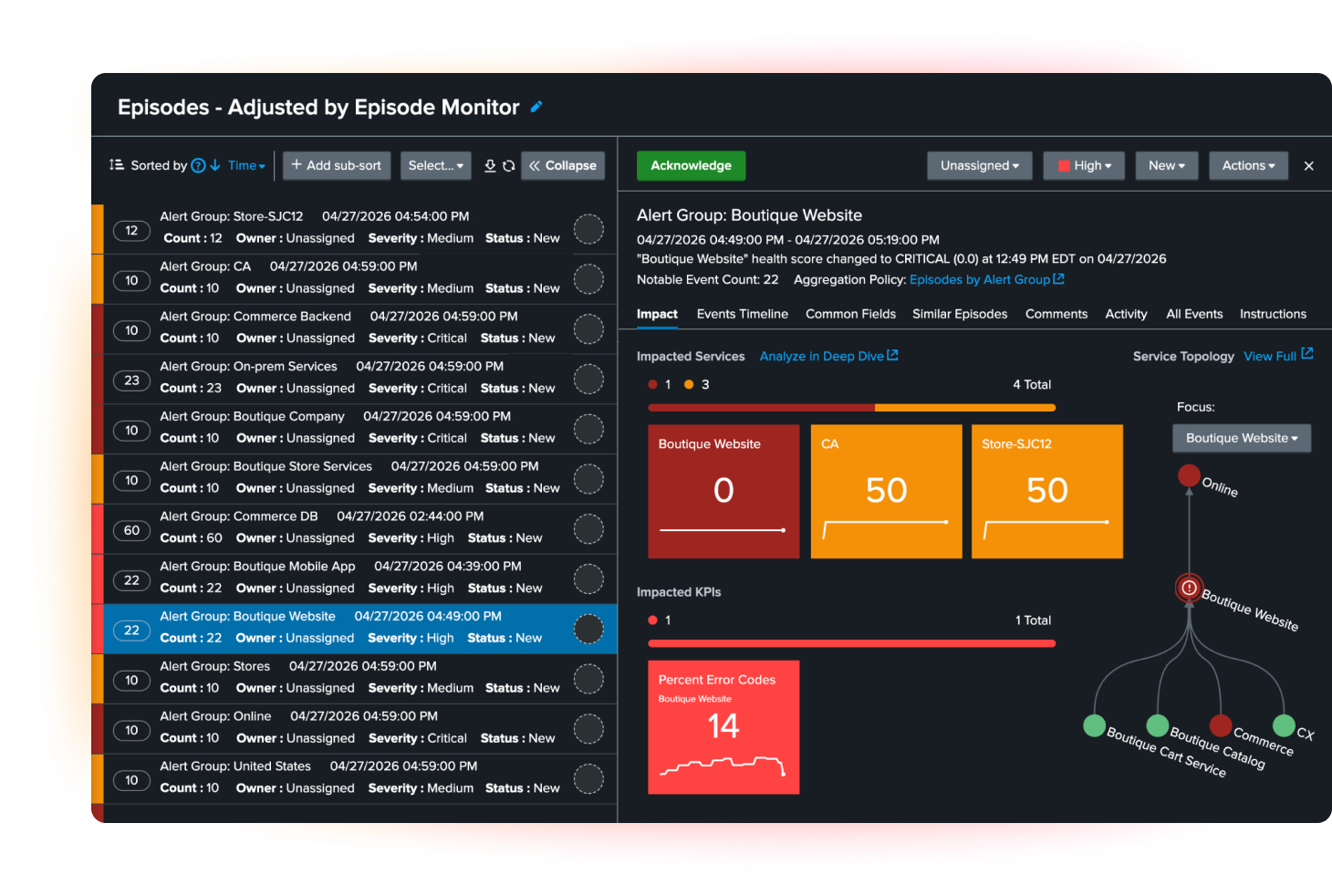
The platform adds service health scoring, KPI-driven glass tables, predictive analytics, and episode-based event correlation on top of Splunk's underlying data. The result is a view of your infrastructure and applications organized around business services — not raw alerts. When an episode fires, ITSI can tell you which KPIs are degraded, which services are affected, and what the predicted trajectory is before it becomes a user-impacting incident.
Cisco's acquisition of Splunk in 2024 introduced some roadmap uncertainty that the market is still processing. The integration with Cisco's network monitoring portfolio is a logical fit — but the pricing and licensing changes that typically follow large acquisitions have made some procurement teams cautious. That said, Splunk ITSI remains one of the most capable platforms for high-volume event environments.
Key features
- ·Service health scoring — composite KPI scores for each service updated in real time; health is always visible at a glance
- ·Glass tables — customizable visual dashboards showing service health, dependencies, and alert status in a single pane
- ·Episode-based event correlation — groups related events into episodes rather than flooding teams with individual alerts
- ·Predictive analytics — ML-powered forecasting detects degradation trends before they cross alert thresholds
- ·Adaptive thresholding — dynamic baselines that adjust to normal patterns, reducing false positives from static rules
- ·Universal data ingestion — handles logs, metrics, traces, and events from virtually any source via Splunk's data platform
Pros
- · 95-99% event noise reduction in high-volume deployments
- · Proven 8-minute improvement in incident response time
- · Service-level context maps infra events to business impact
- · Glass tables provide customizable real-time operational views
- · Handles virtually any data source — broadest ingestion coverage
- · Cisco acquisition could deepen network integration significantly
Cons
- · Only valuable if you're already a Splunk shop — otherwise high barrier
- · Data volume pricing escalates unpredictably at scale
- · Cisco acquisition created roadmap and pricing uncertainty
- · Primarily detection/correlation — execution requires additional tooling
- · Steep Splunk SPL learning curve for teams new to the platform
- · Implementation requires significant Splunk expertise
PagerDuty
Transparent PricingPagerDuty started as an on-call alerting and escalation tool and has evolved into one of the most widely adopted incident response platforms in DevOps and SRE teams. Its 700+ integrations mean it connects to virtually every monitoring, ticketing, and communication tool in a modern stack. Unlike the heavier enterprise platforms, PagerDuty deploys fast — most teams are operational in hours, not weeks.
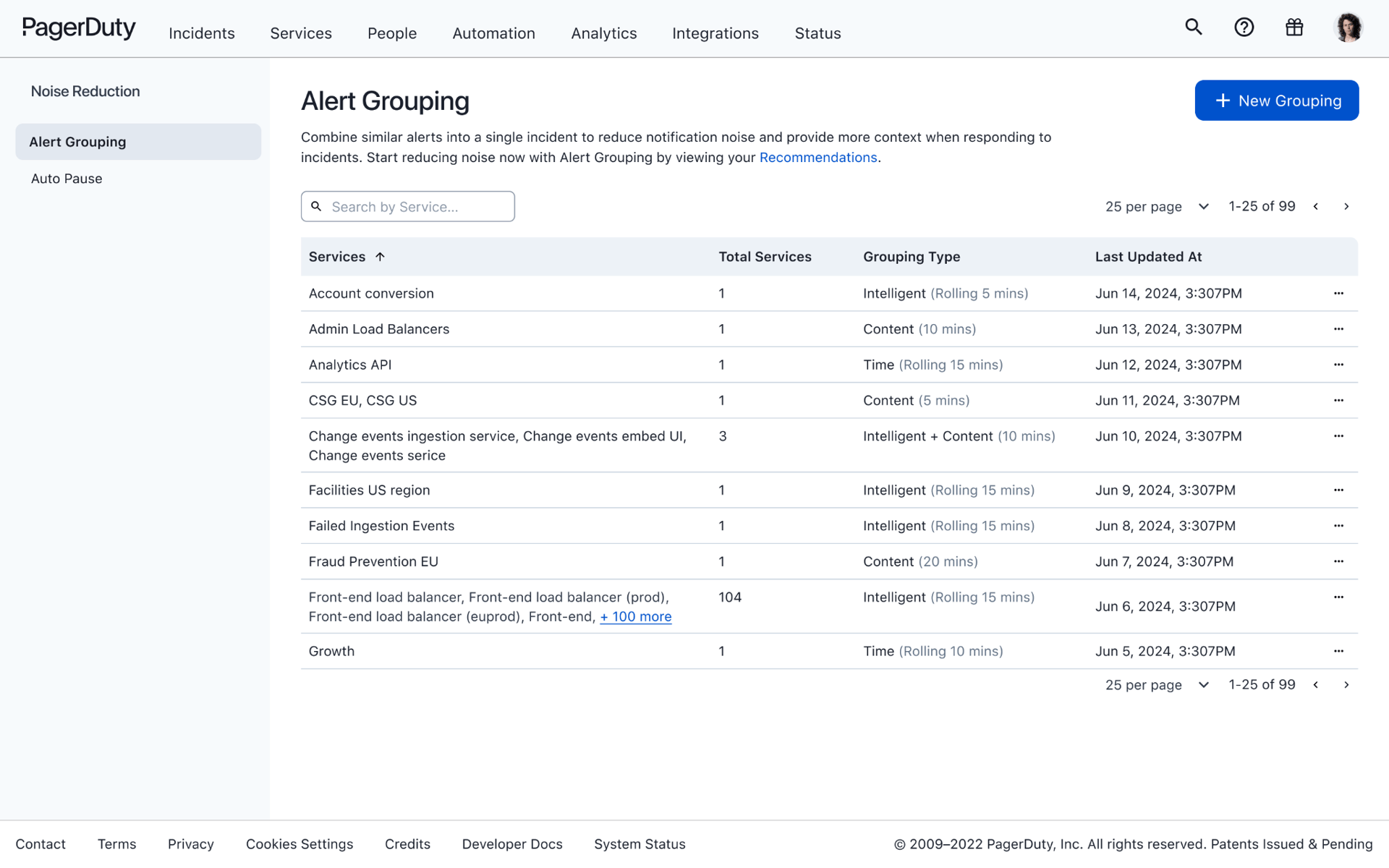
The AIOps layer in PagerDuty centers on Intelligent Alert Grouping, which uses ML to cluster related alerts by contextual similarity and suppress noise during incident storms. The platform also added agentic AI capabilities in 2025, including an autonomous incident investigation agent that can root-cause analysis without human prompting and orchestrate response workflows end-to-end. PagerDuty claims up to 98% noise reduction in production deployments.
The honest caveat is that PagerDuty is strongest as a reactive tool. It excels at routing the right alert to the right person and coordinating the response — but it is not designed for proactive prevention or autonomous remediation. If your primary pain is alert fatigue and on-call burnout, PagerDuty addresses it directly. If you want the platform to actually fix things without human intervention, you'll need additional tooling.
Key features
- ·Intelligent Alert Grouping — ML clusters alerts by context, reducing up to 98% of noise during incident storms
- ·Agentic AI — autonomous incident investigation agent that root-causes and orchestrates response without prompting
- ·Incident Workflows — no-code/low-code automation for response coordination, stakeholder updates, and runbook execution
- ·On-call scheduling — flexible rotation management with escalation policies and override support
- ·700+ native integrations — connects to virtually every monitoring, logging, ticketing, and communication tool
- ·Terraform-managed configuration — infrastructure-as-code support for platform configuration and scaling
Pros
- · Fast time-to-value — operational in hours, not weeks
- · 700+ integrations cover virtually every tool in the modern stack
- · Clean, intuitive UI; strong engineering and SRE culture fit
- · Transparent, published pricing — rare in this market
- · Agentic AI is a meaningful recent addition
- · Auto-escalation keeps incidents moving without manual intervention
Cons
- · Primarily reactive — strong on response, weak on prevention
- · Limited CMDB integration; weak for traditional ITOps/ITSM use cases
- · Not designed for autonomous runbook execution
- · Cost scales significantly with team size and integration depth
- · Better suited to engineering teams than enterprise IT operations
- · SaaS-only — all data processed externally
Datadog
Cloud-Native LeaderDatadog's positioning is deliberate: it is a unified observability platform with AIOps built in, not bolted on. For teams already using Datadog for infrastructure monitoring and APM, the AIOps capabilities — Watchdog anomaly detection, ML-driven alert correlation, and Bits AI SRE — are available without adding another vendor, another integration overhead, or another data pipeline. That consolidation argument is genuinely compelling.
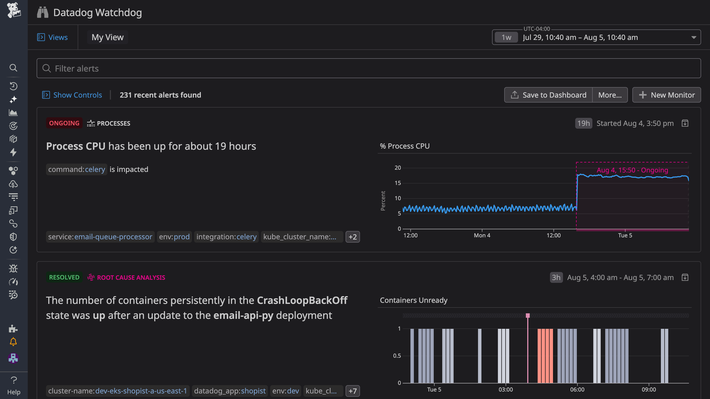
Watchdog AI runs continuously across all your metrics, logs, and traces, automatically surfacing anomalies and correlating them into structured alerts. Bits AI SRE, launched in 2025, takes this further — it operates autonomously as an on-call teammate, investigating incidents, analyzing service dependencies, and providing remediation guidance without requiring a prompt. With 750+ integrations, Datadog covers the broadest ecosystem of any platform in this guide.
The major caveat is pricing. Datadog charges by host for infrastructure monitoring, by volume for logs, separately for APM, separately for synthetics, and separately for several other modules. Surprise billing is the most frequently cited complaint in G2 and Gartner reviews — organizations that deploy broadly find their Datadog bill growing faster than anticipated as usage scales. There is no self-hosted option; all data is processed in Datadog's cloud.
Key features
- ·Watchdog AI — continuously monitors all data streams and automatically surfaces anomalies without manual threshold configuration
- ·Bits AI SRE — autonomous on-call AI teammate that investigates incidents and provides remediation guidance without prompting
- ·Unified MELT platform — metrics, events, logs, and traces in a single data store with unified search and correlation
- ·Service map — auto-generated dependency graph showing real-time service health and traffic flows
- ·750+ integrations — broadest integration ecosystem in the AIOps market
- ·Cloud cost monitoring — FinOps capabilities built into the same platform as performance monitoring
Pros
- · AIOps native — no separate integration or data pipeline required
- · Best-in-class APM and distributed tracing for microservices
- · Watchdog AI requires zero threshold configuration
- · Broadest integration ecosystem (750+)
- · Strong collaboration features — sharable dashboards, notebook-style investigation
- · Frequent releases; fast-moving product roadmap
Cons
- · Surprise billing is the #1 complaint — cost scales aggressively
- · Modular pricing means every feature adds to the bill
- · No self-hosted option — all infrastructure data leaves your network
- · Heavy vendor lock-in once deeply integrated
- · Better for observability than ITSM-integrated remediation
- · Feature sprawl — many orgs pay for capabilities they don't use
BigPanda
Event Correlation SpecialistBigPanda's design philosophy is different from most platforms in this list. Rather than replacing your monitoring stack, it sits above it — ingesting events from every tool you already have, correlating them using ML, and presenting unified incidents instead of a flood of individual alerts. Its Open Integration Manager can connect to virtually any monitoring, CMDB, change management, or ticketing system, making it particularly valuable for enterprises with heterogeneous tool environments.
The platform's headline claim is 95%+ alert noise reduction, and in practice teams typically see 70-90% depending on how well-structured their input data is. What differentiates BigPanda from basic deduplication tools is its IT Knowledge Graph — a unified data model that combines structured data (CMDB, configuration data) with unstructured data (alert text, work notes) to enrich each incident with context before it reaches an operator. Open Box Machine Learning lets teams understand and tune how the correlation model is making decisions, which matters for regulated environments where black-box automation is a compliance concern.
BigPanda's primary limitation is that it is a correlation and routing layer — not an execution layer. It will tell you that an incident is happening, group the right alerts together, and route it to the right team with enriched context. But it doesn't execute runbooks or verify fixes. For organizations that need the full loop from detection to remediation to ticket closure, BigPanda needs to be paired with an execution platform.
Key features
- ·IT Knowledge Graph — unifies structured CMDB data with unstructured alert text to enrich incidents automatically
- ·Open Integration Manager — connects to any monitoring, CMDB, change, or ticketing system without custom code
- ·Open Box ML — transparent, tunable correlation model so teams understand how incidents are being grouped
- ·AI Incident Assistant — interactive AI for escalation support and incident investigation
- ·Change correlation — automatically links incidents to recent changes in your environment to accelerate root cause
- ·Bi-directional ITSM sync — keeps incidents synchronized across BigPanda and your ticketing system in real time
Pros
- · Excellent alert noise reduction — works across heterogeneous tool stacks
- · Open Box ML provides tunable, auditable correlation logic
- · Change correlation is a genuine differentiator for change-heavy environments
- · Fast deployment — no need to replace existing monitoring tools
- · Strong CMDB enrichment reduces manual investigation time
- · Gartner Peer Insights rated 4.3/5
Cons
- · Correlation and routing only — does not execute runbooks or verify fixes
- · SaaS-only — all infrastructure telemetry processed externally
- · Pricing not published; enterprise contracts typically six figures annually
- · ML requires tuning period before noise reduction is optimized
- · Must be paired with an execution layer for full lifecycle coverage
- · Limited value for small teams with simple monitoring setups
IBM Instana / Cloud Pak for AIOps
Gartner Leader 2025IBM plays in two complementary areas here. Instana is an APM and observability platform with AI-assisted root cause and auto-instrumentation built in — acquired by IBM in 2021 and positioned for modern cloud-native workloads. Cloud Pak for AIOps is the heavier platform: Watson-powered event correlation, incident grouping, runbook automation, and service management for complex hybrid environments. Together they represent IBM's full AIOps portfolio.
The genuine differentiator for IBM is legacy infrastructure support. It is the only major AIOps vendor that takes z/OS, AIX, and mainframe-adjacent estates seriously. For organizations running significant on-premises or mainframe infrastructure alongside cloud workloads, IBM Cloud Pak for AIOps is often the only credible option that provides unified visibility across both worlds. IBM was named a Gartner Magic Quadrant Leader for AIOps in 2025, underscoring its continued relevance in enterprise environments.
The tradeoff is implementation complexity. Cloud Pak deploys on OpenShift, which means a significant infrastructure investment before you can run the platform. On the plus side, this means the deployment can be fully on-premises — giving organizations a genuine data sovereignty option, which few other enterprise AIOps vendors offer. Implementation typically requires IBM Professional Services or a certified partner.
Key features
- ·Auto-instrumentation (Instana) — single agent discovers and instruments the entire stack with near-zero configuration
- ·Watson AI correlation — ML-powered event grouping and incident clustering across hybrid infrastructure
- ·Runbook automation — pre-built and custom runbooks for automated remediation with approval workflows
- ·Legacy infrastructure support — z/OS, AIX, and mainframe monitoring that no other AIOps vendor matches
- ·On-premises deployment via OpenShift — genuine data sovereignty option for regulated industries
- ·Change risk assessment — AI-powered change analytics to predict the risk of proposed changes before execution
Pros
- · Only enterprise AIOps vendor with mature mainframe/legacy support
- · On-premises deployment option provides genuine data sovereignty
- · Watson AI handles complex hybrid event relationships well
- · Runbook automation is more mature than many competitors
- · Gartner Magic Quadrant Leader (2025)
- · Instana's auto-instrumentation is genuinely fast to deploy
Cons
- · Complex portfolio — Instana and Cloud Pak have overlapping positioning
- · OpenShift deployment is a heavy infrastructure requirement
- · Implementation typically requires IBM services or certified partner
- · UI lags behind modern SaaS competitors in usability
- · Enterprise-only pricing; high barrier to entry
- · Less relevant for cloud-native-first organizations
BMC Helix AIOps
Enterprise ITSMBMC Helix AIOps is the AIOps layer built into BMC's enterprise ITSM platform — the natural home for organizations running BMC Remedy or Helix ITSM as their ticketing and service management backbone. Like ServiceNow, BMC's advantage is contextual depth: incidents are automatically enriched with CMDB data, change history, and service relationships before they reach an operator.
The 2025 platform added HelixGPT, a generative AI capability that produces post-incident analysis narratives, root cause summaries, and remediation recommendations in natural language. In regulated industries where audit trails and post-incident documentation are mandatory, this reduces the time ops teams spend writing work notes by a meaningful margin. BMC Helix earns the highest customer satisfaction score of any platform in this guide on Gartner Peer Insights — 4.8/5 — though that rating comes from a smaller sample of primarily long-term BMC customers.
Key features
- ·HelixGPT — generative AI for post-incident narratives, root cause summaries, and remediation recommendations
- ·Predictive anomaly detection — ML-based detection of degradation before it crosses alert thresholds
- ·CMDB-aware correlation — incidents enriched with service relationships and configuration data automatically
- ·Automated remediation workflows — pre-built and custom scripts with approval gates for high-risk actions
- ·On-premises deployment option — data sovereignty available for regulated environments
- ·Closed-loop ITSM integration — native integration with BMC Remedy for full incident lifecycle management
Pros
- · HelixGPT genuinely reduces post-incident documentation burden
- · Deep CMDB integration for service-aware incident context
- · On-premises option available for data sovereignty
- · Highest Gartner Peer Insights satisfaction (4.8/5)
- · Strong in regulated industries (financial services, healthcare, government)
- · Mature remediation workflow capabilities
Cons
- · Best value only for existing BMC Remedy/Helix customers
- · UI is dated compared to modern SaaS competitors
- · Slow release cadence relative to cloud-native platforms
- · Enterprise-only pricing; not accessible for mid-market
- · Heavy implementation burden; requires dedicated BMC expertise
- · Limited appeal outside traditional ITSM-centric organizations
ScienceLogic SL1
Topology SpecialistScienceLogic SL1 is designed for enterprises managing large, distributed, and hybrid infrastructure where understanding topology is the prerequisite to everything else. Its core differentiation is cross-domain data collection with automatic topology mapping — SL1 discovers physical and logical infrastructure relationships continuously and uses parent-child correlation to understand which alerts are symptoms versus causes before grouping them.
For organizations running networks, data centers, and cloud workloads simultaneously — particularly in government, telco, and healthcare — SL1 provides a level of infrastructure visibility that cloud-centric tools struggle to match. Documented outcomes include a 23% MTTR reduction in a healthcare deployment and a 30% reduction in Priority 1 incidents across hybrid environments.
Key features
- ·Automatic topology mapping — continuously discovers and maps physical and logical infrastructure relationships
- ·Parent-child event correlation — uses topology to suppress symptom alerts when root cause is identified upstream
- ·Cross-domain data collection — unified collection across network, server, storage, cloud, and applications
- ·Hybrid IT visibility — handles legacy on-premises and modern cloud environments in a single view
- ·Deep customization — highly configurable collection policies and correlation rules for non-standard environments
- ·SaaS and on-premises options — flexible deployment to match data sovereignty requirements
Pros
- · Best-in-class topology mapping for hybrid infrastructure
- · 23% MTTR improvement and 30% P1 reduction documented
- · Deep network monitoring — telco and enterprise network-heavy orgs
- · Handles legacy and modern infrastructure in the same view
- · On-premises deployment option available
- · Strong in regulated sectors (government, healthcare, telco)
Cons
- · Limited and inconsistent documentation — slow onboarding
- · Requires significant expertise to unlock advanced features
- · UI complexity is a frequently cited barrier
- · Not designed for autonomous remediation — detection and correlation only
- · Smaller community and ecosystem than Dynatrace or Datadog
- · Less suited for cloud-native-first or DevOps-oriented teams
Dell Apex AIOps (formerly Moogsoft)
Dell Acquired 2023Moogsoft was one of the early pioneers of ML-based alert noise reduction, known for its adaptive thresholding and alert deduplication capabilities. Dell Technologies acquired Moogsoft in September 2023 and has since rebranded the product as Apex AIOps, integrating it into Dell's broader infrastructure portfolio and adding sustainability metrics and a GenAI interface for ticket triage.
The historical track record is solid — documented outcomes include 50% noise reduction in financial services deployments, 33% MTTR improvement, and 62% reduction in help desk ticket volume. The GenAI interface added in 2024 claims a 44% reduction in ticket triage time, which is consistent with what generative AI brings to structured incident data.
The key uncertainty with Apex AIOps is roadmap direction. Post-acquisition, the platform is increasingly positioned as a component of Dell's hardware and infrastructure ecosystem rather than a standalone AIOps product. Organizations running Dell infrastructure — PowerEdge, PowerStore, VxRail — have the most to gain. For heterogeneous or non-Dell environments, the value proposition is less clear than it was under the independent Moogsoft brand.
Pros
- · Strong historical track record on alert noise reduction
- · GenAI interface reduces ticket triage time by 44% (Dell data)
- · 33% MTTR and 62% help desk ticket reduction documented
- · Adaptive thresholding that evolves with your environment
- · Dell infrastructure integration pathway
- · SaaS delivery — relatively fast to deploy
Cons
- · Acquisition created roadmap uncertainty; Moogsoft brand retired
- · Increasingly positioned for Dell hardware ecosystems
- · Weaker value for non-Dell infrastructure environments
- · Documentation was thin pre-acquisition; not materially improved
- · Reduced independence as a standalone AIOps product
- · SaaS-only — no self-hosted option
Axiometica AIR
This is our platformAxiometica AIR is our platform. We've included it in this comparison because it belongs in the conversation — and we want to be honest about where it fits and where it doesn't. Judge the comparison accordingly.
Axiometica AIR was built around a specific design constraint: infrastructure telemetry should never leave your network. For security-conscious organizations, regulated industries, and teams who read Gartner's data sovereignty research and nodded, that constraint is not optional — it is a prerequisite. Every other platform in this guide routes your incidents, logs, and failure signatures to an external SaaS environment. Axiometica AIR does not.
The platform covers the full incident lifecycle — from signal detection to ticket closure — without a human in the loop unless the risk threshold requires it. AI handles the judgment layer: qualifying ambiguous signals, enriching incidents with CMDB context, selecting runbooks when multiple apply, and drafting the work notes. Deterministic pipelines handle execution: when a runbook runs, it runs the same way every time. When a risk threshold is crossed, the system stops and routes for human approval without exception.
Axiometica AIR is early stage. It does not have the enterprise support contracts, the SI partner ecosystem, or the decade of production deployments that ServiceNow or Dynatrace have. Local LLM setup requires more initial configuration than a SaaS tool. The integration ecosystem is growing. These are real limitations and we're not going to soften them. What it offers in return: full incident lifecycle coverage, data sovereignty by design, and free for internal use — deployed on a single VM with Docker Compose.
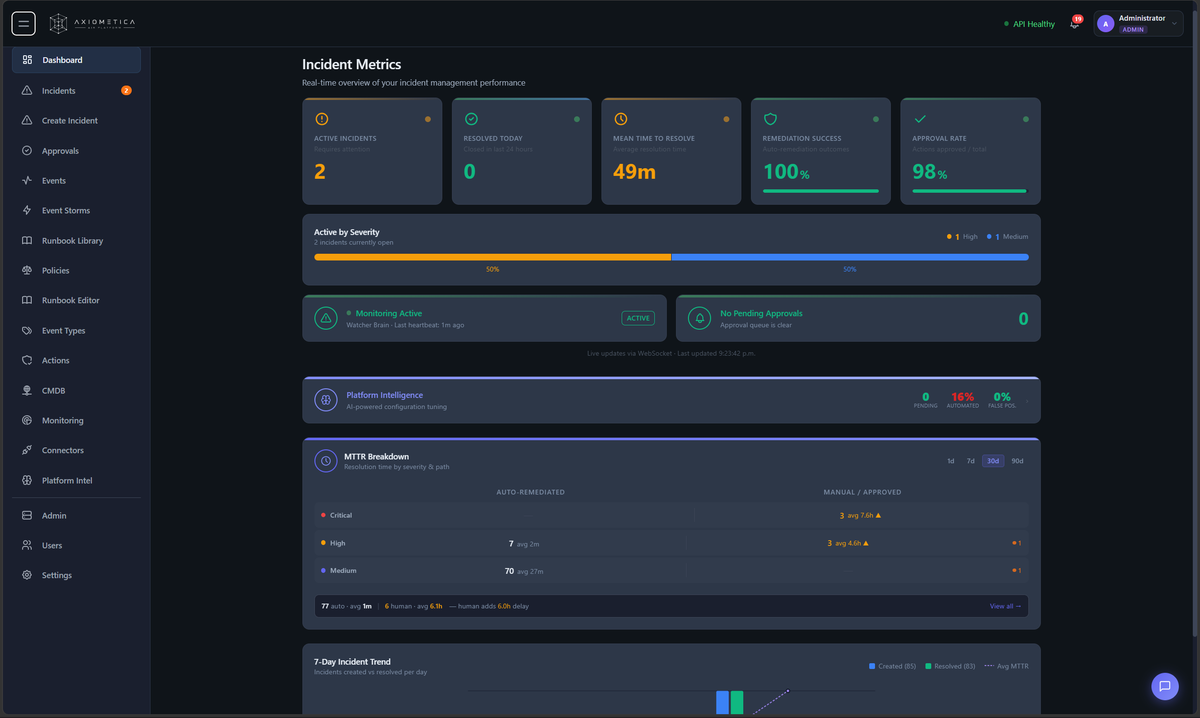
Axiometica AIR — incident management console with CMDB-enriched incident view and runbook execution status
Key features
- ·Local LLM support — Ollama-compatible; bring your own model or connect to a remote LLM. Your choice, your data.
- ·Full incident lifecycle — detection → signal qualification → CMDB enrichment → runbook selection → execution → verification → ticket closure with work notes
- ·Deterministic execution layer — runbooks run identically every time; no non-deterministic AI in the execution path
- ·Configurable risk thresholds — define where human approval is required; everything else executes autonomously
- ·CMDB integration — live infrastructure context enriches every incident before qualification
- ·Single VM deployment — Docker Compose; no Kubernetes, no OpenShift, no infrastructure team required to get started
Pros
- · Data sovereignty by design — telemetry never leaves your network
- · Full incident lifecycle — detection through ticket closure
- · Deterministic execution layer is auditable and compliance-friendly
- · Human-in-the-loop approval built in at configurable risk thresholds
- · Simple deployment: Docker Compose, single VM
- · Free for internal use; no per-seat or per-host pricing
Cons
- · Self-hosted means you manage the infrastructure
- · Smaller integration ecosystem than established vendors
- · LLM setup requires more initial configuration than SaaS tools
- · Community and documentation still growing
Summary comparison
| Platform | Data stays local | Self-hosted | Full lifecycle | Transparent pricing | Best fit |
|---|---|---|---|---|---|
| Dynatrace | ✗ | ✗ | Partial | ✗ | Cloud-native enterprise |
| ServiceNow ITOM | ✗ | ✗ | ✓ | ✗ | Existing ServiceNow shops |
| Splunk ITSI | Partial | Partial | Partial | ✗ | Splunk-heavy shops |
| PagerDuty | ✗ | ✗ | Partial | ✓ | DevOps / SRE teams |
| Datadog | ✗ | ✗ | Partial | Partial | Cloud-native monitoring |
| BigPanda | ✗ | ✗ | ✗ | ✗ | Multi-tool enterprises |
| IBM Instana / Cloud Pak | Partial | Partial | ✓ | ✗ | Hybrid / mainframe shops |
| BMC Helix AIOps | Partial | Partial | ✓ | ✗ | BMC / Remedy shops |
| ScienceLogic SL1 | Partial | Partial | Partial | ✗ | Network-heavy / hybrid |
| Dell Apex AIOps | ✗ | ✗ | Partial | ✗ | Dell infrastructure shops |
| Axiometica AIR | ✓ | ✓ | ✓ | ✓ | Security / regulated / sovereign |
How to choose
The right platform depends less on feature lists and more on where your organization is and what constraint matters most.
You're already on ServiceNow or BMC
Use their AIOps modules. The CMDB context and closed-loop integration you already have is worth more than a best-of-breed point solution.
You're cloud-native, DevOps-oriented, and alert fatigue is the primary pain
PagerDuty or Datadog depending on whether your problem is routing (PagerDuty) or observability consolidation (Datadog).
You need causal AI and deep observability across a complex cloud environment
Dynatrace is the benchmark. The cost is real but so are the outcomes at enterprise scale.
You have heterogeneous monitoring tools and your problem is alert correlation
BigPanda or Splunk ITSI. BigPanda if you want to keep your existing tools; Splunk ITSI if you're already on Splunk.
Data sovereignty is a requirement, not a preference
IBM Cloud Pak (complex, enterprise-grade) or Axiometica AIR (simpler, open code, free for internal use). Both deploy on-premises. The tradeoff is maturity versus accessibility.
You run a hybrid or network-heavy environment with legacy infrastructure
ScienceLogic for topology-first visibility. IBM Cloud Pak for AIOps if mainframe or AIX is in the picture.
If data sovereignty is your constraint, Axiometica AIR is worth 20 minutes of your time. Self-hosted, local LLM support, free for internal use.